

Explore travel through pop culture tourism with us on Pop Passport podcast and instagram. Shop for travel essentials on the curated storefront.
As a big fan of history, art, literature, and Paris, few films in my mind capture the dreamy, nostalgic magic of the city like Midnight in Paris. It’s a love letter to the city, yes, but also to art, literature, and the feeling that Paris is always just a little more alive at night. If you’ve ever wanted to follow in Gil Pender’s footsteps—wandering cobblestoned streets, brushing up against history, and waiting for that antique Peugeot to whisk you back to the 1920s—this guide is for you.
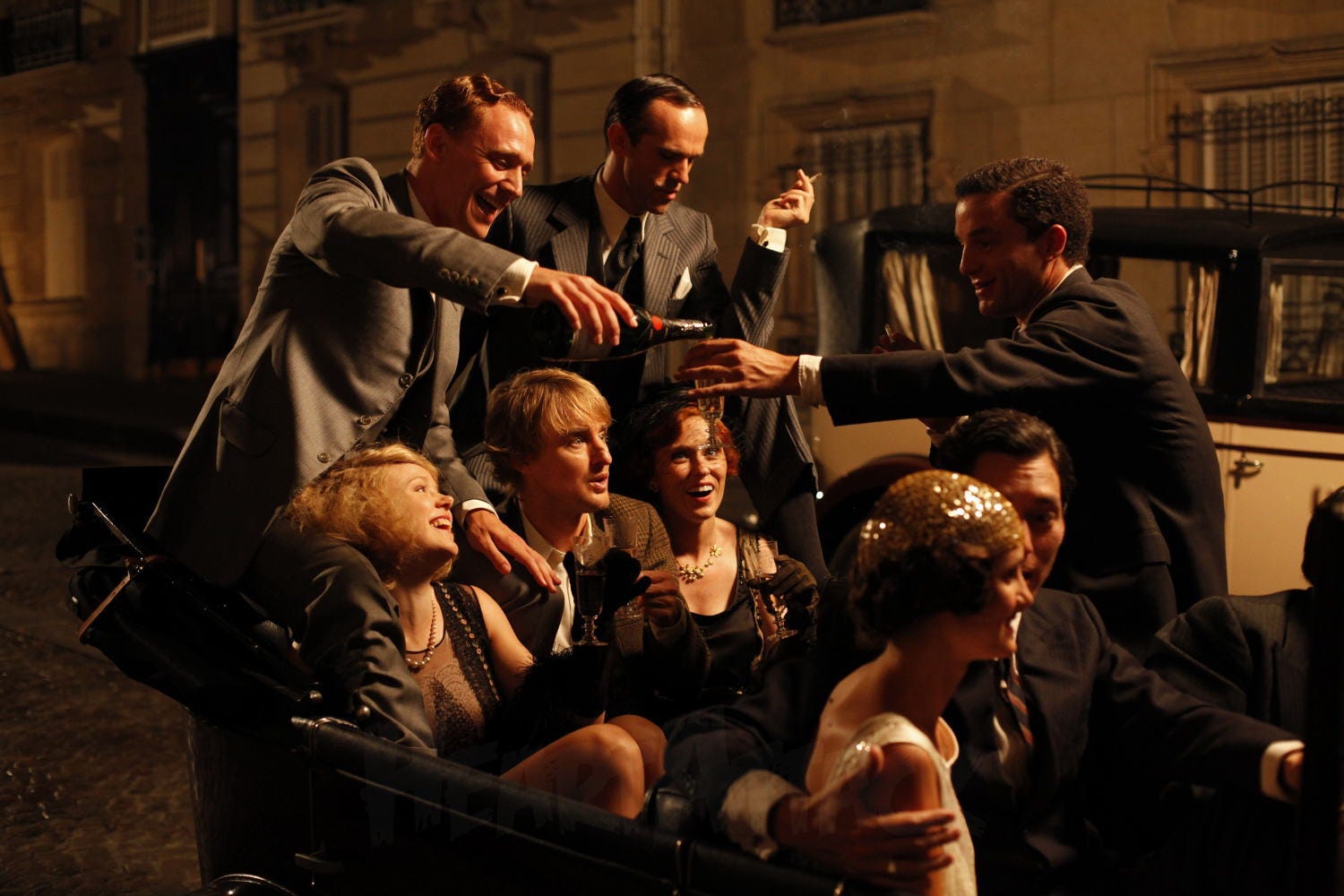
Of course, there were many famous writers and artists of the 1920’s “lost generation”, as well as some famous figures from their stop in Belle Époque era. Let’s review for some inspiration:
The 1920s “Lost Generation” crowd
F. Scott Fitzgerald & Zelda Fitzgerald – The glamorous, troubled American literary couple.
Ernest Hemingway – The hard-drinking, hyper-masculine novelist who gives Gil blunt advice on life and writing.
Gertrude Stein – The influential modernist writer and salon host who critiques Gil’s manuscript.
Pablo Picasso – The revolutionary painter, seen with his mistress of the time, Adriana.
Salvador Dalí – The surrealist painter, played for laughs (with a fixation on rhinoceroses).
Luis Buñuel – Spanish filmmaker, friend of Dalí, who listens to Gil’s movie idea.
Man Ray – Surrealist photographer, another Dalí-Buñuel companion.
Cole Porter – The American composer, playing piano at one of the Fitzgeralds’ parties.
Josephine Baker – Jazz-age entertainer and icon, glimpsed in the party scenes.
Henri Matisse – Not a character, but his work and influence are mentioned.
The Belle Époque (1890s–1910s) crowd
Henri de Toulouse-Lautrec – The post-impressionist painter of Paris nightlife.
Paul Gauguin – Post-impressionist painter, known for his Tahitian works.
Edgar Degas – Impressionist painter, known for ballerinas and café scenes.
Broader references
James Joyce – Mentioned as part of Stein’s circle, though not depicted onscreen.
T.S. Eliot – Referenced as part of the expatriate literary scene.
Henri Rousseau – Briefly invoked in dialogue.
The film was shot extensively around the city, including locations including the Eiffel Tower, Montmartre's Sacré-Cœur Basilica steps (where the time-traveling begins) and rue du Chevalier-de-la-Barre,"the Musée de l'Orangerie (for the Monet paintings), the St-Étienne-du-Mont church steps on Montagne Sainte-Geneviève, and the Palace of Versailles. Other notable spots are Deyrolle, the Louvre Museum, Pont Neuf, the Musée d'Orsay, and the Café de Flore. Here are more real-life locations where Midnight in Paris was filmed—and why you should add them to your Paris itinerary.
1. Pont Alexandre III
The opening montage of the film is a Paris postcard in motion, and Pont Alexandre III is one of its stars. With its ornate lamps and golden statues, this Beaux-Arts bridge is the perfect place to start your journey. Visit at sunrise for a quiet, romantic view, or at sunset when the Eiffel Tower begins to sparkle nearby.
2. Shakespeare and Company
Gil and Inez stroll past this legendary English-language bookstore, a must-stop for any book lover. It’s where Hemingway, Fitzgerald, and other Lost Generation icons once gathered. Today, you can browse the shelves, attend readings, or just soak up the atmosphere. Don’t miss the upstairs reading room—it feels frozen in time.
3. Musée Rodin
The gardens here provide the backdrop for Gil and Inez’s outing with Paul and Carol (remember the pedantic art lecture?). Beyond cinematic nostalgia, the Musée Rodin is one of Paris’s loveliest museums, where sculptures like The Thinker live among roses and fountains.
4. Palace of Versailles
Though not in central Paris, the day trip to Versailles in the film is unforgettable. Stroll through the Hall of Mirrors or lose yourself in the sprawling gardens. Just remember Gil’s glazed-over look when Paul starts explaining French history—sometimes beauty is best experienced, not overanalyzed.
5. Quai de la Tournelle & Rue du Cardinal Lemoine
This quiet Left Bank corner is where Gil waits for the vintage Peugeot that transports him back to the Jazz Age. Standing there at midnight, it’s easy to imagine the car pulling up, door swinging open to a party with Scott and Zelda Fitzgerald. Bring a bottle of wine and a friend for your own midnight magic.
6. Maxim’s de Paris
When Gil is transported back to La Belle Époque, he finds himself at Maxim’s, the famous Art Nouveau restaurant that has been dazzling Parisians since 1893. The interiors are just as opulent today—though a dinner here will set you back more than a baguette and brie.
7. Musée des Arts Forains
A true hidden gem. This whimsical private museum of carnival rides and games from the 19th and 20th centuries provides the backdrop for one of the Belle Époque parties. You need to book in advance, but it’s worth it to step inside this surreal, nostalgic wonderland.
8. Saint-Étienne-du-Mont
The church near the Pantheon, with its stunning steps, is the very spot where Gil sits when the car arrives. Many fans now make the pilgrimage to perch on those steps at midnight—just in case.
How to Experience Midnight in Paris for Yourself
By Day: Walk the film’s montage route—bridges, cafés, gardens—and imagine the city through Gil’s wide-eyed wonder.
By Night: Bring a notebook (channel your inner struggling novelist), sit on a café terrace, and people-watch. Paris glows differently under the streetlamps.
With Curiosity: Duck into small bookshops, old jazz clubs, or vintage cafés. The film reminds us that the magic of Paris lies as much in serendipity as in landmarks.
Midnight in Paris isn’t just a movie—it’s an invitation to experience the city as both present and timeless. When you walk these streets, you’re not only following in Gil’s footsteps—you’re joining a century of dreamers, artists, and romantics who have been enchanted by Paris after dark.